
Data Integrity
Confidence that the underlying numbers are accurate and consistent.
Can leadership rely on data that is accurate, complete, consistent and timely?
Decision Readiness is the ability to make consequential choices with information you trust, visibility you can use, and planning that prepares you for change.

Confident decisions rest on nine questions. The AdvisureIQ Decision Readiness Architecture organizes them into three layers — Information, Planning, and Execution — each building on the one beneath it. None is a software product or a substitute for leadership judgment.
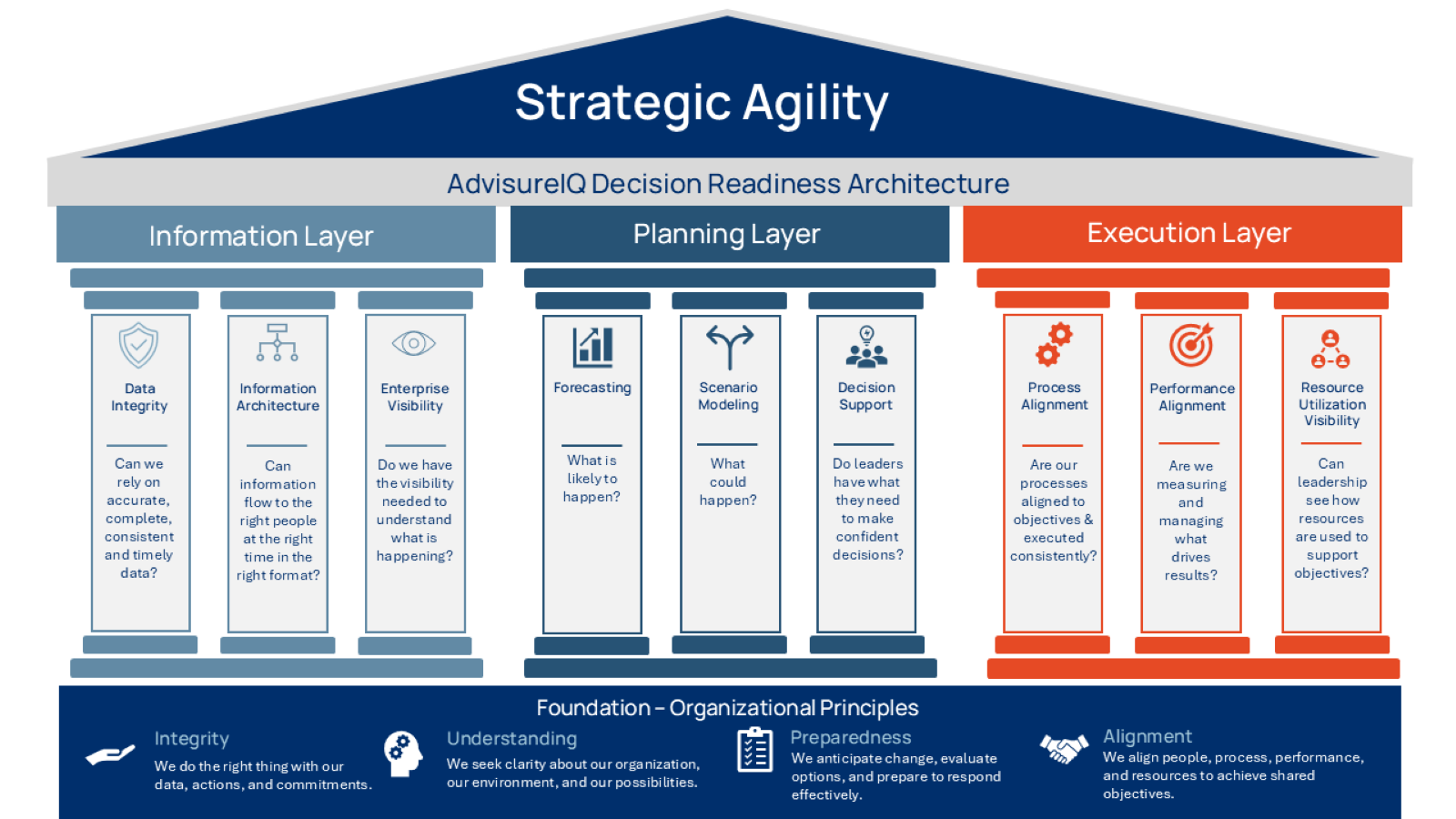
Confidence that the underlying numbers are accurate and consistent.
Can leadership rely on data that is accurate, complete, consistent and timely?
A coherent way to connect and organize essential business information.
Does information reach the right people at the right time in the right format?
A shared view of what is happening across the organization.
Is there enough visibility to understand what is happening?
A disciplined view of what could lie ahead, grounded in current realities.
What is likely to happen?
A way to examine alternatives before circumstances demand a response.
What could happen?
Relevant context that helps leaders weigh choices with confidence.
Do leaders have what they need to make confident decisions?
Working practices that move information to the people who need it.
Are processes aligned to objectives and executed consistently?
Measures that connect performance with organizational priorities.
Is the organization measuring and managing what drives results?
A clearer picture of how capacity and resources are being used.
Can leadership see how resources are being used?
The principles that support how information, planning, and execution come together.
Most mid-market companies can answer a few of these questions well. Few can answer all nine. The distance between them is where decisions get slower, more expensive, and less certain. Closing that distance produces Strategic Agility.
Spot inconsistencies and blind spots earlier.
Give leadership a stronger basis for changing conditions.
Make the context around important choices more dependable.
Decision Readiness develops progressively—from reacting to what has already happened to using trusted information, forecasting, and planning to prepare for what could happen.
The Decision-Readiness Assessment identifies where information, planning, and execution are working together—and where they are not.
Assess Your Decision Readiness