Get Your Decision Readiness Assessment Today!
See where your organization's Strategic Agility stands: just 13 questions in 10 minutes.

Flying Below the Cloud Deck
Visibility is unlimited when you fly at 4,000 feet. Most companies never reach that altitude. AdvisureIQ builds the planning architecture that gives leadership clarity.
David Van Horn, CPA
5/22/20262 min read

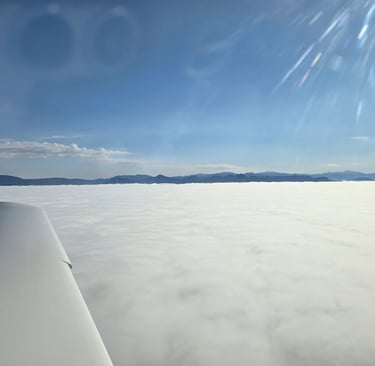
This morning I flew from Van Nuys to Carlsbad.
At 4,000 feet, conditions were perfect with smooth air, bright sun, and unlimited visibility. Directly below me was Los Angeles, where millions of people were stuck in gridlock, going nowhere. From my altitude, you would never know any of it was happening.
I've been thinking about that image ever since I landed.
Most of the companies we work with operate at street level. From the outside, they look fine. Revenue is coming in. The team is working hard. The company is surviving. But inside, chaos is on every corner.
Finance rebuilds the same reports every month from spreadsheets that produce numbers no one agrees on.
Leadership requests data and receives figures that are days old and misaligned with what department heads are tracking.
Modeling a hiring scenario or evaluating an acquisition takes weeks.
The annual budget is obsolete before the first quarter ends.
Leadership eventually stops questioning these conditions and manages within them.
We see this pattern across industries and ownership structures. The particulars change. The pattern doesn't.
To reduce the chaos, most organizations buy tools before they've defined what they're planning for. They implement a platform, automate some reports, and call it a data strategy. The spreadsheet chaos migrates into the new system. Cycle times improve marginally. The structural problems stay intact.
What breaks the pattern is building the planning architecture before selecting any technology.
That means defining strategic objectives first. It means, specifically:
Establishing KPIs tied to business outcomes, not just financial line items;
Rationalizing data across finance, operations, and business units until leadership has one version of the numbers they can trust; and
Re-engineering the budgeting and forecasting process to move from a static annual plan to a rolling forecast that reflects how the business operates.
Then the technology selection follows because at that point you know precisely what the technology needs to accomplish.
The result of planning first and implementing tools second:
Organizations build foundations that reduce budget and forecast cycle times;
Finance teams stop consolidating spreadsheets and start doing strategic analysis;
Leadership teams run scenario models in just hours, not weeks;
Executives get real-time visibility into what's driving performance; and
The planning process stops being a backward-looking exercise in accounting and becomes a forward-looking tool for decisions.
That's what we mean by Clarity Through Connected Intelligence. It's not a tagline about better dashboards. It's a description of what becomes possible when strategic intent, financial planning, and operational execution are connected.
Flying above the cloud deck doesn't eliminate the traffic below. It gives you enough altitude to see where the congestion is building before you're in it.
The companies that scale well are not the ones pushing hardest through chaos. They're the ones that build altitude.
Address
2035 Corte Del Nogal, Suite 125
Carlsbad, CA 92011
Contacts
© 2025 - AdvisureIQ, Inc. All Rights Reserved
Join the Clarity Cult (Kidding…kinda)