Get Your Decision Readiness Assessment Today!
See where your organization's Strategic Agility stands: just 13 questions in 10 minutes.
When Survival Buys Time, Not a Strategic Future
A story about how daily survival deceptively replaces long-term strategy, and how AdvisureIQ brings the outside perspective required to shift from reactive decisions to strategic leadership.
David Van Horn, CPA
7/21/20263 min read
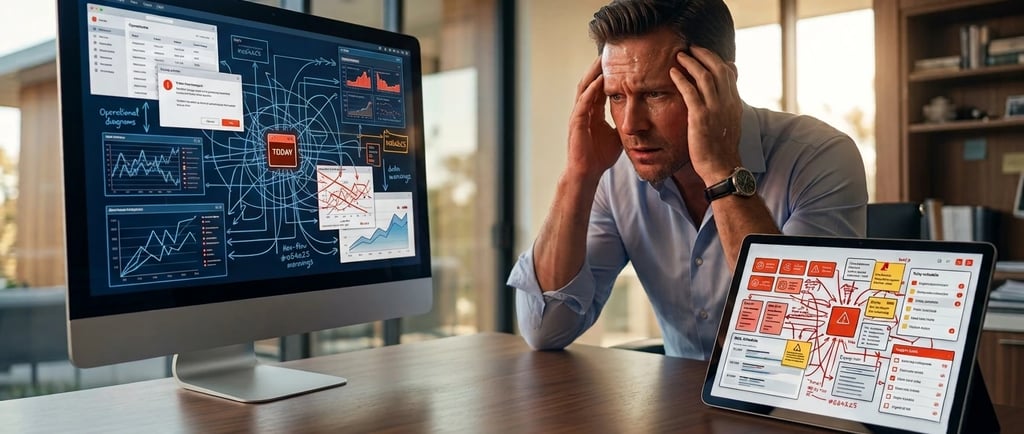

I've spent enough years around business owners to know there's a moment every struggling company eventually reaches. It isn't when sales start slipping. It isn't when the first bill gets paid late, and it isn't even when cash gets tight. The real turning point comes when the owner stops thinking about next month because they're completely consumed by tomorrow.
I've watched it happen more than once.
At first, the conversations are optimistic. "It's just a slow week." Then it becomes, "It's the weather." A holiday weekend. Customers are on vacation. Road construction. Maybe it's the economy. Maybe it's politics. Maybe it's something that will pass in another week or two. Sometimes those explanations are correct, and sometimes they aren't. Either way, they become easier to focus on than the problems that have been quietly building underneath the surface.
When Tomorrow Replaces Next Quarter
As cash becomes tighter, the questions begin to change. Instead of discussing growth or new opportunities, the conversation shifts toward survival. Can we buy enough inventory to get through the week? Which vendor can wait a few more days? Can we make payroll? Do we pay the mortgage or buy more product? Would a short-term loan get us through until business picks back up?
None of those are strategic questions. They're survival questions, and every business owner eventually faces them. Markets change, customers disappear, weather affects sales, and industries evolve. Those challenges are simply part of owning a business. The danger isn't asking those questions. The danger comes when survival quietly becomes the operating model.
When that happens, planning slowly disappears. Owners who once thought six or twelve months ahead find themselves measuring success one day at a time. Every morning begins with a different emergency, and every evening ends with the hope that tomorrow will simply be a little better than today. Without realizing it, the business begins running the owner instead of the owner running the business.
When Motion Feels Like Progress
That's what makes survival so deceptive. It feels productive because you're constantly moving. You're solving problems, returning phone calls, juggling cash, negotiating with vendors, and working harder than you've ever worked before. But despite all that activity, very little of it is making the business stronger. It's simply keeping it alive long enough to face the next challenge.
I've seen incredibly capable owners become trapped in that cycle. They weren't poor operators, and they certainly weren't lazy. They didn't suddenly forget how to run a business. They simply became so consumed by today's problems that they no longer had the capacity to solve tomorrow's.
When Perspective Requires Distance
From the outside, it often looks like a cash-flow problem. From the inside, it's usually something much larger. The business has gradually lost the ability to step back, see itself objectively, and make decisions based on where it needs to go instead of where it happens to be today. Every decision becomes reactive because there simply isn't enough time or energy left to think any other way.
That's one of the reasons outside perspective becomes so valuable during difficult times. Not because someone else understands your business better than you do—they don't—but because they're not carrying the weight of every payroll, every vendor payment, every slow sales day, and every sleepless night. They have enough distance to ask the questions that are almost impossible to ask when you're standing in the middle of the storm. Is this really a temporary cash-flow problem, or has the business fundamentally changed? Which products are actually profitable? Where is cash getting trapped? What decisions are being made because of today's bank balance instead of next quarter's plan?
When Leadership Replaces Reaction
Those aren't accounting questions. They're leadership questions.
The strongest businesses aren't the ones that never face difficult seasons. Every company does. The difference is that healthy businesses use difficult periods to make better decisions, while struggling businesses spend every day reacting to the next problem. Survival can buy you time, but it was never meant to be the strategy.
Address
2035 Corte Del Nogal, Suite 125
Carlsbad, CA 92011
Contacts
© 2025 - AdvisureIQ, Inc. All Rights Reserved
Join the Clarity Cult (Kidding…kinda)